
More than two years after a disputed screening encounter at Austin-Bergstrom International Airport, the Transportation Security Administration is seeking to impose a civil penalty against a Texas traveler who contends TSA personnel mistreated him, ignored a disclosed medical condition, cursed at him, and later accused him of misconduct.
The traveler maintains that recordings, written complaints, medical documentation, and other evidence support his account.
TSA disputes those allegations.
What makes the case remarkable is that no neutral factfinder has ever determined which version of events is correct.
No TSA employee has testified under oath.
No witness has been cross-examined.
No evidentiary hearing has been held.
No findings of fact have been issued.
Instead, after more than two years of disputes, complaints, conferences, and motions, TSA prevailed on a procedural argument that may allow the agency to impose a penalty without ever having to defend its version of events in a hearing.
The Incident
According to filings in TSA Case No. 2024AUS0208, the dispute began during a TSA screening at Austin-Bergstrom International Airport.
The traveler states that he informed TSA personnel of a pre-existing groin injury and requested accommodations consistent with TSA procedures governing medically sensitive screenings.
According to the traveler, those accommodations were not properly provided.
He contends TSA personnel proceeded with a sensitive-area screening despite his medical disclosure and failed to follow procedures designed to protect travelers with medical concerns.
The traveler further alleges that TSA personnel later engaged in additional unwanted physical contact after he questioned what had occurred.
TSA disputes those allegations.
Yet despite the seriousness of the claims, no hearing has ever been held to determine what occurred.
“I Don’t Have to Tell You Shit”
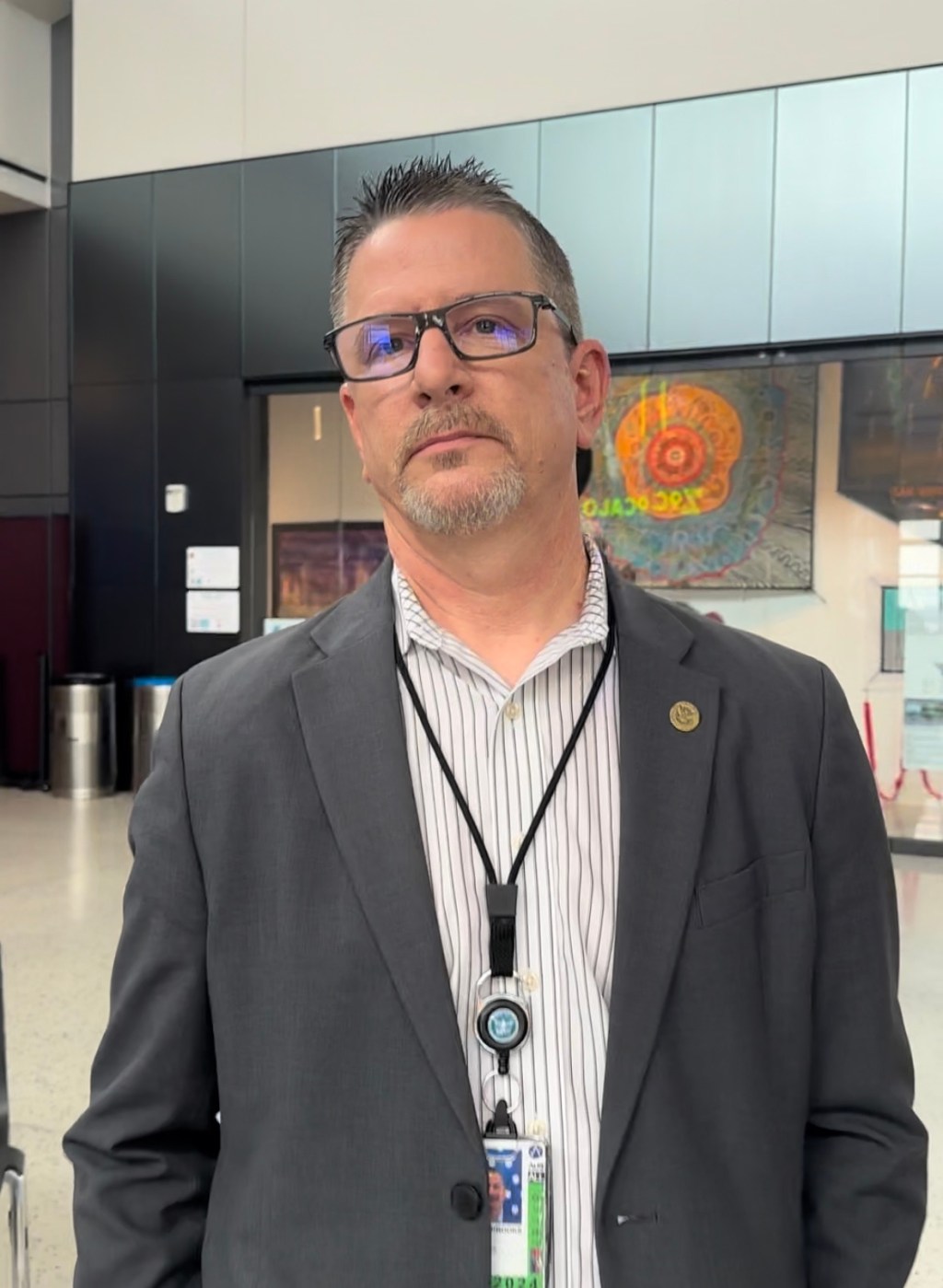
One of the most disputed aspects of the encounter involves TSA Supervisor Shawn Brooks.
According to the traveler, Brooks responded to a request for identifying information by stating:
“I don’t have to tell you shit.”
The traveler contends that statement reflected a broader attitude he encountered throughout the incident.
The traveler ultimately filed complaints involving five separate TSA employees arising from the encounter.
According to the traveler, those complaints were timely submitted, documented in writing, and supported by evidence.
Competing Allegations
The case now consists of competing accusations.
The traveler alleges misconduct by TSA personnel.
TSA alleges misconduct by the traveler.
The traveler contends that after he filed complaints regarding TSA employees, allegations were pursued against him that now form the basis of TSA’s effort to impose a civil penalty.
Whether those competing allegations have merit has never been determined.
No testimony has been taken.
No witnesses have been cross-examined.
No factual record has been developed through a hearing.
The Recordings and Transcript
According to the traveler, recordings exist documenting portions of the interactions at issue.
The traveler further states that he prepared and provided a detailed written script derived from those recordings identifying what he contends TSA personnel said, what he said, and the sequence in which those statements occurred.
According to the traveler, the purpose of providing the script was to ensure that factual disputes would be evaluated using the best available evidence rather than memory, assumptions, or later characterizations.
The traveler contends that agency summaries and memoranda nevertheless attributed statements to him that do not appear in the script and that he disputes making.
Those disputes are significant because they go directly to credibility and to the factual basis of the enforcement action.
Yet the recordings and transcript have never been examined in a formal evidentiary hearing.
No neutral factfinder has compared the recordings against the agency’s characterizations.
No witness has been questioned regarding those differences.
The Kimberly Garcia Conference
A central figure in the case is TSA Senior Counsel Kimberly Garcia, who represented the agency during the informal conference process and later moved to dismiss the hearing request.
According to the traveler, the informal conference was supposed to provide an opportunity to review evidence and determine whether the matter could be resolved without formal litigation.
Instead, the traveler says he left the conference believing that the evidence was never meaningfully addressed.
The traveler contends that Garcia repeatedly focused on matters unrelated to the core factual disputes while critical evidence received little attention.
Among the traveler’s criticisms is that Garcia repeatedly suggested he was recording the conference despite his denial that he was doing so.
The traveler states that he found those accusations particularly frustrating because they became a distraction from the evidence he was attempting to discuss.
The traveler also contends that Garcia referenced agency terminology and acronyms that she later acknowledged she could not explain.
Most significantly, the traveler disputes portions of the agency’s subsequent characterization of the conference and the underlying facts.
According to the traveler, Garcia later relied on a version of events that conflicted with the script and evidence he had already provided.
TSA disputes the traveler’s characterization of the conference and the underlying facts.
More Than 100 Hours
According to the traveler, he spent more than 100 hours gathering evidence, preparing filings, reviewing records, filing complaints, responding to TSA allegations, and attempting to obtain a hearing.
He estimates the value of that time at more than $10,000.
Throughout the process, he consistently maintained that he wanted a hearing if the matter could not be resolved informally.
He wanted witnesses.
He wanted testimony.
He wanted cross-examination.
He wanted the evidence examined.
Instead, the case ultimately turned on a deadline.
The Procedural Victory
After the traveler rejected a settlement proposal, TSA argued that his request for a hearing was untimely.
Garcia moved to dismiss the hearing request.
The administrative law judge agreed and concluded that sufficient good cause had not been shown for the delay.
As a result, the case never reached the stage where evidence would be formally presented and tested.
The ruling did not determine whether TSA personnel followed policy.
The ruling did not determine whether TSA personnel acted appropriately.
The ruling did not determine whether the traveler’s allegations were true.
The ruling did not determine whether TSA’s allegations were true.
The ruling addressed a procedural issue.
That distinction matters.
A procedural victory is not a determination of the facts.
Appeals Continue
The matter is not over.
The traveler intends to pursue all available administrative appeals and continues to seek a hearing on the merits.
The recent ruling resolved a procedural question.
It did not resolve the underlying factual disputes.
Those disputes remain exactly where they were before the ruling: unresolved.
The Bigger Question
The TSA is seeking a civil penalty of approximately $4,000.
For many Americans, that is a substantial amount of money.
Yet hiring counsel to fully litigate a federal administrative enforcement case can easily cost more than the penalty itself.
The result is a system in which a citizen can spend years gathering evidence, filing complaints, participating in agency conferences, and attempting to obtain a hearing, only to discover that the underlying facts may never be examined because of a procedural mistake.
Reasonable people may disagree about the deadline issue.
Reasonable people may disagree about the allegations.
What cannot be disputed is that more than two years after the incident occurred, the central factual questions remain unanswered.
The TSA may ultimately collect a penalty.
But so far, it has never had to prove its case before a neutral factfinder.
And after more than two years, the most important question remains unanswered:
What actually happened at Austin-Bergstrom International Airport?
 Texas Reporter