
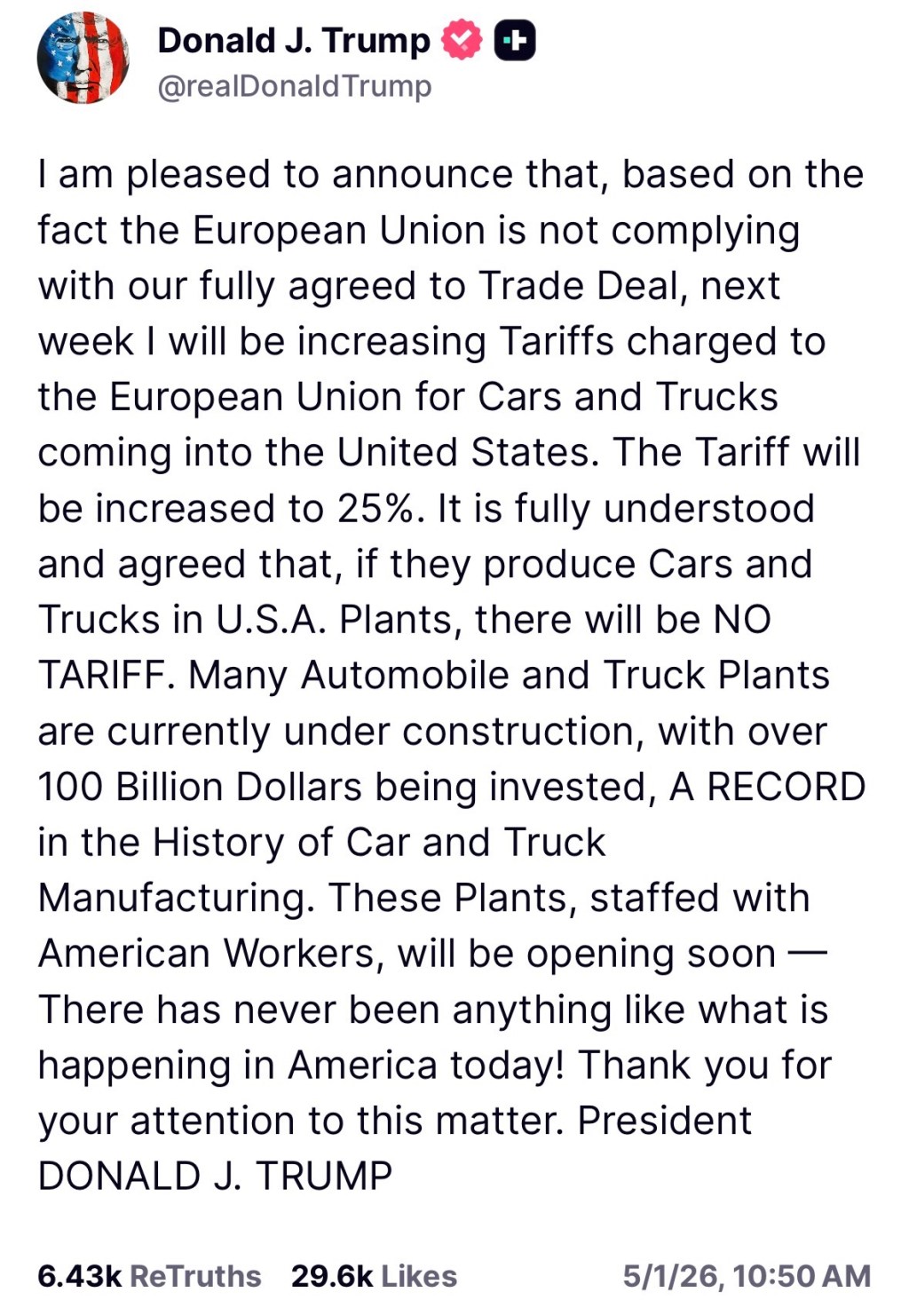
Donald Trump said Friday the United States will increase tariffs on cars and trucks imported from the European Union to 25% beginning next week, a move that threatens to escalate trade tensions and disrupt the global auto industry.
In a social media post, Trump accused the EU of failing to comply with a trade agreement reached in 2025 that had capped tariffs on most goods, including vehicles, at 15%. European officials quickly rejected that claim and warned of possible retaliation.
The announcement effectively reverses part of that agreement and reintroduces higher duties that had previously been reduced to ease transatlantic trade friction. Economists and industry analysts say such abrupt changes increase uncertainty for businesses operating across U.S. and European markets.
Tariffs on imported vehicles are typically passed through supply chains, raising costs not only for foreign automakers but also for U.S. companies that rely on imported parts or sell European-made models. Industry groups warn the increase could push up consumer prices, disrupt production planning and weigh on demand.
Financial markets reacted quickly, with shares of major automakers declining amid concerns about higher costs and a potential trade conflict. The European Commission said it would defend its economic interests, raising the possibility of countermeasures that could further impact U.S. exports.
Trump has argued the tariffs will encourage foreign automakers to expand manufacturing in the United States, noting that companies have already committed tens of billions of dollars to domestic plants. However, economists caution that any gains in domestic production may be offset by retaliatory tariffs and higher input costs, limiting the overall economic benefit.
The move comes at a time of broader geopolitical and economic strain, including elevated energy prices and ongoing international tensions, factors that have already contributed to inflation and supply chain volatility.
With trade negotiations unresolved and both sides signaling firm positions, analysts say the tariff increase could mark the beginning of a new phase of U.S.-EU trade friction, with consequences for businesses and consumers on both sides of the Atlantic.

