
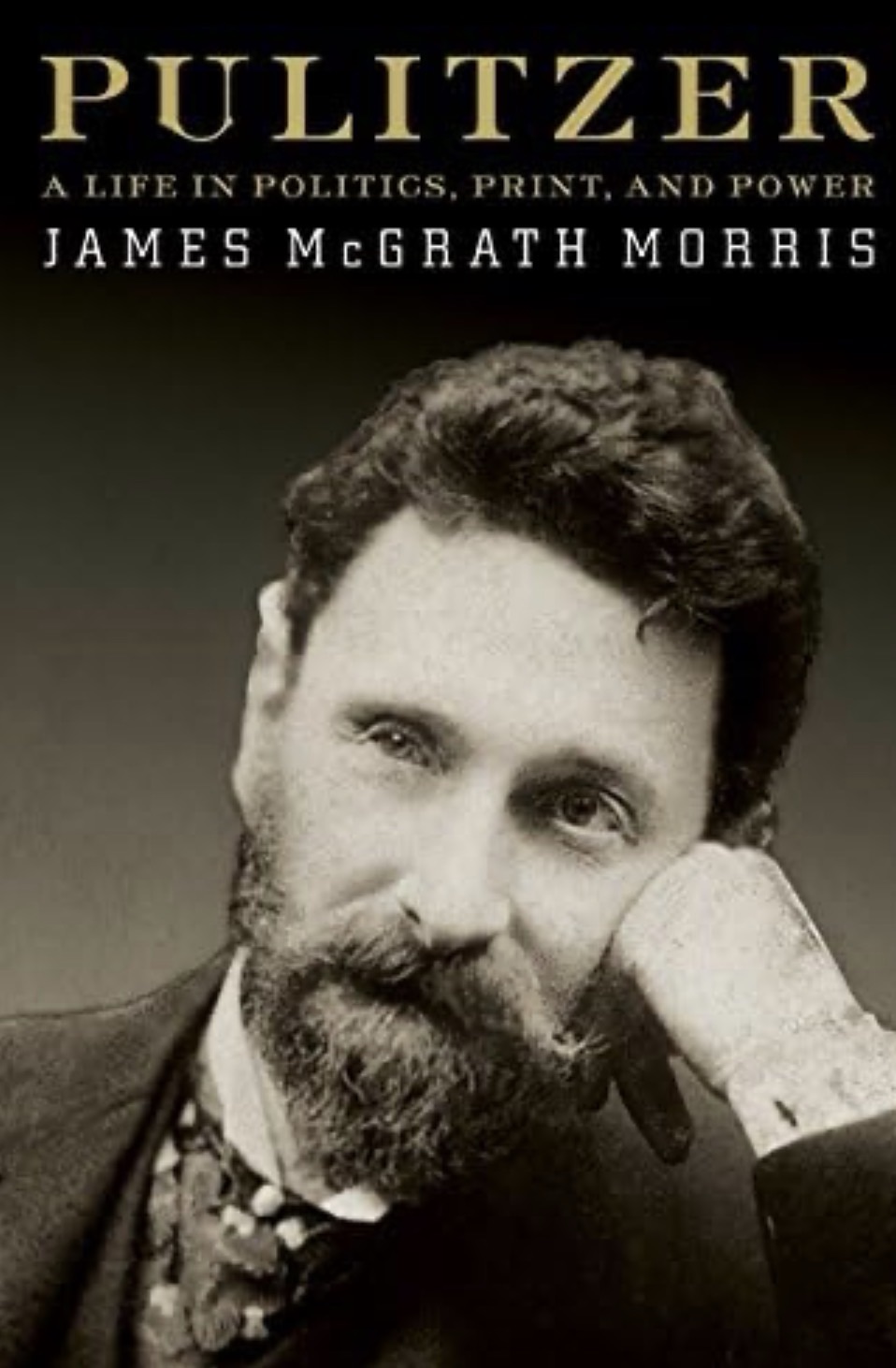
Pulitzer: A Life in Politics, Print, and Power by James McGrath Morris is often treated as a biography of Joseph Pulitzer. But read closely—especially through the passages you’ve pulled—it becomes something much bigger:
It is a story about immigration, opportunism, entrepreneurship, media power, and civic ambition, all converging in one life.
It is also, unmistakably, the origin story of the modern media system.
An Unlikely Beginning: A Substitute in Someone Else’s War
Pulitzer did not arrive in the United States as a future titan of journalism. He came as a Civil War substitute—part of a system where men could pay others to serve in their place.
That detail matters more than it first appears.
It places Pulitzer at the very beginning inside a transactional system:
People were assets
Service could be bought
Intermediaries profited
He wasn’t stepping into an idealized America—he was stepping into a marketplace of opportunity shaped by incentives, imbalance and negotiation.
From the start, Pulitzer was learning how systems really worked.
Seeing Value Where Others Didn’t
One of the most revealing entrepreneurial moments in the book is how Pulitzer made his first real money.
He didn’t earn it slowly. He recognized mispriced value and moved fast.
He acquired a newspaper asset, held it briefly—less than a couple of days—and flipped it for a profit.
That wasn’t luck. That was instinct:
Identify undervalued assets Understand the market Execute quickly
In modern terms, it’s arbitrage. In historical terms, it’s the clearest signal of what Pulitzer would become:
A builder who understood leverage.
Building a Media Machine
From that early moment, Pulitzer scaled.
He didn’t just run newspapers—he reimagined them.
The book shows how he leaned into:
illustrations and visual storytelling bold headlines emotionally resonant coverage
Not because he was lowering standards, but because he understood something fundamental:
Attention is the gateway to influence.
In a world where competing papers looked identical, Pulitzer made his stand out. He turned the newspaper into something people didn’t just read—they engaged with.
That shift is the foundation of modern media.
It Was Never Just About Money
What separates Pulitzer from a pure opportunist is that it mattered to him.
He believed the press could:
expose corruption challenge power serve the public
And he acted on that belief.
He wasn’t content to simply profit from attention—he wanted to direct it toward outcomes.
That’s why his newspapers took strong positions, made enemies, and pushed aggressively on issues. He saw conflict not as a byproduct, but as a tool.
From Publisher to Public Office
Pulitzer didn’t stop at influencing politics—he entered it.
He ran for office and served, stepping directly into the system his newspapers were covering.
From a media historian’s perspective, this is critical.
It underscores a truth the book makes unavoidable:
The press is not separate from power. It is part of it.
Pulitzer understood that if you’re shaping the conversation, you’re already in the arena.
Rivals Who Defined the Industry
Pulitzer’s story is inseparable from his competitors—especially William Randolph Hearst and Adolph Ochs.
Together, they form three enduring models of media:
Pulitzer: Mass appeal with reformist intent Hearst: Maximum scale and emotional intensity Ochs: Credibility, discipline and institutional trust
Hearst pushed Pulitzer’s model toward spectacle, proving that attention could be amplified almost without limit.
Ochs pushed back, demonstrating that restraint and credibility could also be a competitive advantage.
Modern media still operates somewhere along this spectrum.
The System Was Always Messy
Morris makes clear that there was no golden age of pure journalism.
Pulitzer operated in a world where:
newspapers had political alliances publishers made deals influence and coverage were intertwined
That doesn’t undermine journalism—it contextualizes it.
The ethical tensions we see today were present from the beginning:
public service vs. profit truth vs. engagement independence vs. influence
Pulitzer didn’t resolve these tensions. He built a system that made them scale.
The Cost of Building
Late in life, Pulitzer’s health declined. He became increasingly isolated, even as his influence remained vast.
The same intensity that allowed him to build something from nothing also took a toll.
That’s another thread running quietly through the book:
Building something meaningful often comes at a personal cost.
What the Book Teaches
Read as a whole, Pulitzer: A Life in Politics, Print, and Power offers lessons that extend far beyond journalism:
You can start with nothing—even as a substitute in someone else’s war—and still build something massive Opportunity belongs to those who understand systems, not just those who participate in them Value is often hidden—those who see it first win Attention is the most powerful asset in media—and beyond If it matters to you, you’ll push further, take risks, and endure the consequences Power compounds when you step into the arena, not just observe it
Final Thought
Before the prizes, before the legacy, before his name became shorthand for excellence, Joseph Pulitzer was:
an immigrant navigating a transactional system a young man flipping assets to get ahead an entrepreneur building from nothing a publisher who believed his work mattered and a participant in the very power structures he covered
That’s what makes this book resonate.
It’s not just the story of journalism.
It’s the story of how influence is built—and why the people who build it shape everything that follows.
 Texas Reporter