
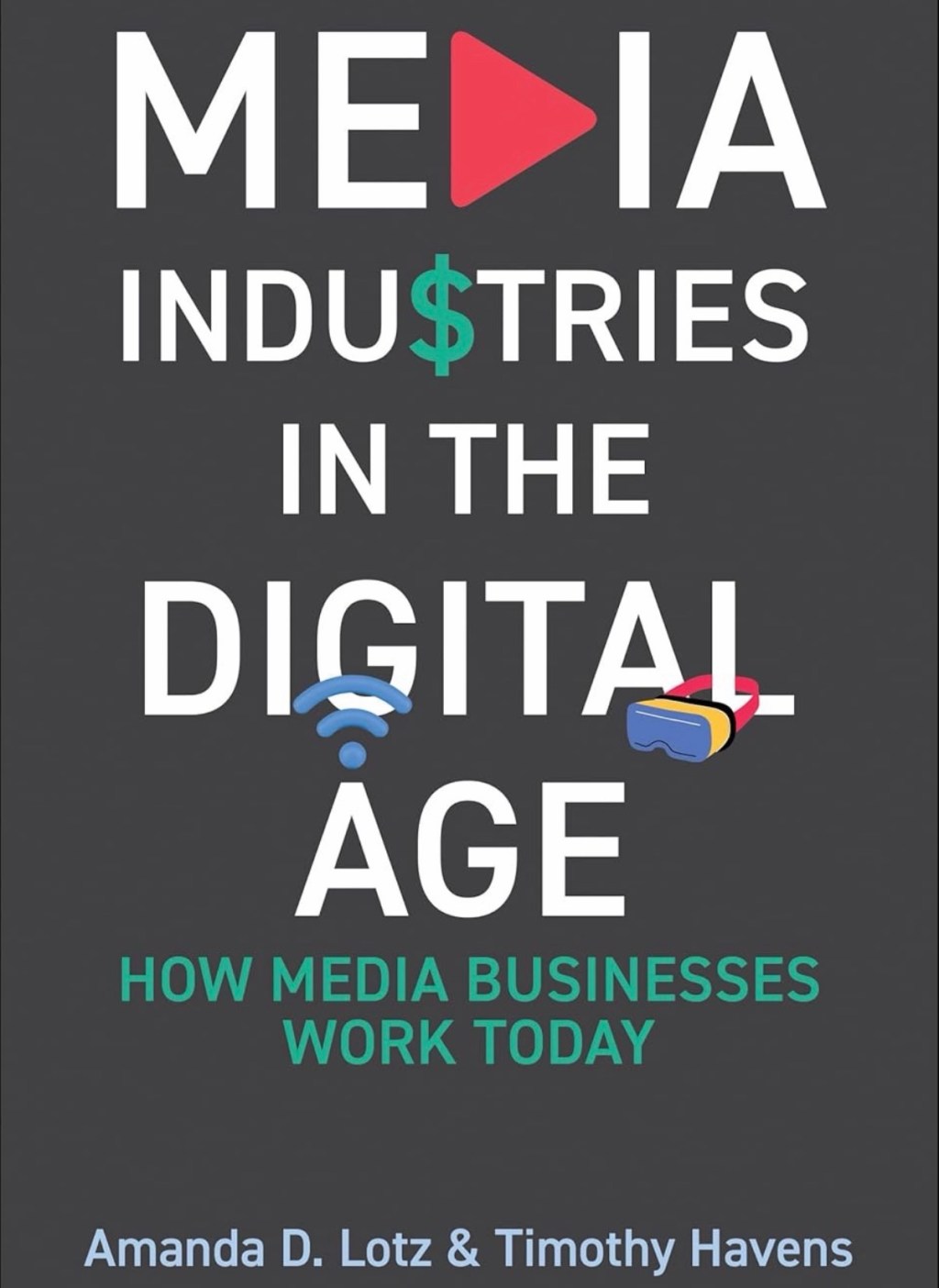
Amanda D. Lotz and Timothy Havens’ Media Industries in the Digital Age: How Media Businesses Work Today is best understood not simply as a study of media, but as a study of the economic systems that determine what media can exist in the first place. Across its chapters, the book makes a consistent and compelling argument: content is not primarily shaped by creativity or technology alone, but by the mechanisms that fund, distribute, and measure attention.
At the center of this framework is the recognition that media has long operated as a dual-product market. As the authors explain, “the media good is the first of the ‘dual’ products… [it] attracts the audience… which becomes the second product that is the basis of the economic transaction.” Media is therefore not only about informing or entertaining audiences; it is about producing attention that can be sold.
For much of the twentieth century, this system functioned under conditions of scarcity. Newspapers, radio, and television were “the best available advertising tools” because they could reliably gather large audiences in limited channels. Advertisers could be confident that a “sizable percentage” of a local or national audience would encounter their message. Scarcity created value, predictability, and stability.
Digital distribution has dismantled that foundation.
The book repeatedly returns to the consequences of attention abundance. There are now “many, many places for ads,” and “having so many places for ads makes the ads less valuable.” This shift does not simply dilute advertising effectiveness—it restructures the economics of entire industries. As attention fragments across platforms, feeds, and devices, the pricing power that once sustained bundled media products collapses.
This is particularly evident in the discussion of newspapers and other ad-supported media. In print, scarcity of space and audience concentration created both scale and limitation. Online, that scarcity disappears. The result is not merely declining revenue, but a system in which the underlying economic logic of the product no longer holds.
Crucially, the book reframes this disruption in stark terms: “It’s not a media problem, it’s an advertising problem.” The challenges facing journalism and other media sectors are not primarily failures of content or public interest, but consequences of shifts in how advertising functions. New tools—especially search and targeted advertising—have proven more efficient for advertisers. As the authors note, search allows companies to place messages “in front of a consumer precisely when they are looking for their product,” a capability fundamentally different from traditional attention-attraction media.
As a result, “these other ways of advertising… are taking up more of their budgets,” and “this has reduced the money available to media such as television and newspapers.” The economic base has shifted, and media organizations have had to adapt accordingly—or struggle.
The rise of platform dominance further complicates this landscape. Despite the proliferation of content, the ability to organize and sell attention remains concentrated. The observation that “lots of sites to buy attention but few sellers does not yield a competitive marketplace” captures this dynamic succinctly. Platforms such as Google and Meta function not merely as participants, but as infrastructure—controlling access, measurement, and monetization simultaneously.
This concentration is accompanied by opacity. Advertisers often “don’t know what they don’t know… given the exceptional opacity of what attention they buy,” and yet dependence on these systems persists. The paradox is striking: “ad sales outside the marketplaces managed by Google and Meta are reputedly less reliable,” reinforcing the dominance of the very systems that obscure transparency.
The implications for content creation are profound. Media does not simply respond to audience demand; it responds to the conditions under which attention can be monetized. The book challenges the assumption that mass culture is the natural state of media, noting that “mass audience and mass culture… were actually an unusual moment in history.” The current environment—defined by fragmentation and microcultures—is not an aberration, but a reversion to a more typical condition, now amplified by digital distribution.
This shift reshapes content strategies. Large-scale “mass hits” become rarer, while niche content and targeted audiences gain prominence. Even highly successful cultural products reflect deliberate economic strategies, such as balancing scarcity and availability to maximize engagement and revenue.
At the level of labor, the expansion of access has not resolved longstanding structural challenges. Media industries have always faced an oversupply of labor, and digital distribution has intensified this condition. While more individuals can now participate in media creation, “media work still remains unsustainable for many more.” The distinction between those who leverage platforms to scale into larger opportunities and those who build sustainable niche operations reflects different responses to the same economic constraints.
Importantly, the book does not treat simple-professional media as merely an alternative to legacy systems. It is both a site of opportunity and a space shaped by the same underlying dynamics: attention must be captured, and revenue must flow through increasingly centralized monetization systems.
Legacy media, when successful, demonstrates adaptation to these realities rather than resistance to them. The example of The New York Times illustrates how shifting from advertising reliance to subscription models can reestablish economic viability. The lesson is not that quality alone ensures success, but that alignment between content and revenue model is essential.
The book’s final sections extend this analysis into emerging technologies such as generative AI. Rather than framing AI as a simple replacement for human creativity, the authors situate it within the same economic logic. While “story ideas, treatments, and drafts of dialogue are already being generated,” and “AI-generated images have been mainstream,” the likely outcome is not total automation but transformation. Media industries will increasingly involve combinations of human and machine labor, shaped by incentives, ownership, and control.
Across all of these domains, the central argument holds: media is not defined solely by what can be created, but by what can be funded, distributed, and sustained within existing economic systems.
Media Industries in the Digital Age succeeds because it avoids both nostalgia and hype. It neither mourns the past nor celebrates disruption uncritically. Instead, it offers a grounded, analytical framework for understanding why media looks the way it does today—and how it may continue to evolve.
For those interested in the media industry, the book provides a clear and durable insight: to understand content, it is necessary to understand the systems that pay for it.
 Texas Reporter