
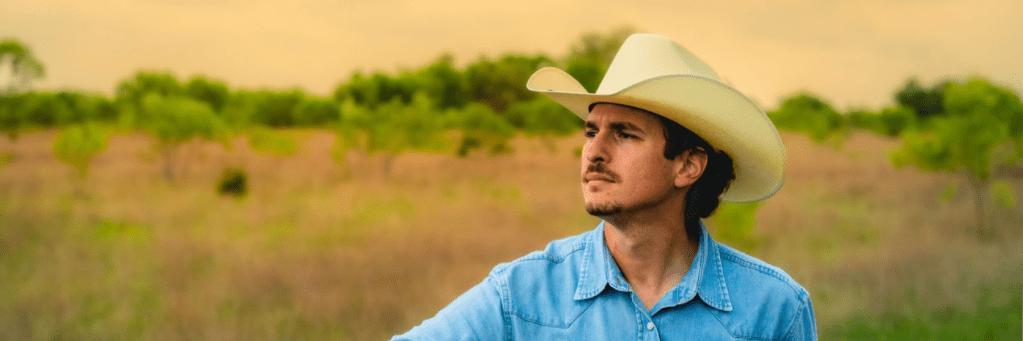
Clayton Tucker, a Central Texas rancher, organizer and former educator, is mounting a challenge to incumbent Sid Miller in the race for Texas Agriculture Commissioner, running on a platform centered on breaking up corporate concentration in agriculture, protecting rural communities, and re-orienting the office toward everyday Texans rather than large donors.
Tucker’s campaign frames the Agriculture Commissioner’s office as one of the most consequential—but often overlooked—statewide positions in Texas, arguing that its decisions directly affect food prices, water access, rural healthcare, and land use across the state.
Roots in Central Texas Agriculture
Tucker grew up working on his family’s ranch, RX Ranch, in Lampasas County, where he learned ranch work at an early age—baling hay, mending fences, and tending livestock including cattle, goats, sheep and pigs. He attended school in Georgetown during the week while continuing to work on the ranch on weekends and summers. His mother worked at the Texas Railroad Commission, giving him early exposure to state government alongside agricultural life.
That background forms a core part of his campaign identity, which emphasizes family-scale farming and ranching rather than large corporate operations.
Education and Work Abroad
After high school, Tucker attended Southwestern University, studying international politics with a minor in Mandarin. During and after college, he worked as a water researcher with funding from the National Science Foundation and later studied at National Chengchi University in Taipei.
He eventually became a kindergarten teacher, an experience his campaign highlights as shaping his views on public service, education, and community stability.
Organizer and Political Work
After returning to Texas, Tucker worked on the family ranch while founding a small business, Grassroots Nation, and becoming involved in progressive organizing. He later worked with former Texas Agriculture Commissioner Jim Hightower, lobbying the state government on issues including healthcare access.
Tucker has been involved in several political and advocacy organizations, including:
Founding board member of Killeen Creators, a community garden initiative Member of the State Democratic Executive Committee Founder of the Texas Progressive Caucus Secretary of the Texas Farmers Union Organizer with the Trade Justice Education Fund, focusing on fair-trade and agricultural policy
Like many Texas family farmers—his campaign cites a figure of roughly 90 percent—Tucker also relies on off-farm income to support ranch operations.
Campaign Focus: Corporate Consolidation and Fair Markets
A central theme of Tucker’s campaign is opposition to what he describes as “shared monopolies” in the food system. His campaign materials cite industry consolidation statistics, including claims that four corporations control large portions of the meat, seed, dairy, and processed food markets.
Tucker argues that this concentration inflates food prices for consumers while squeezing farmers on the production end, undermining both rural economies and household budgets. He contrasts this with what he describes as a “monopoly market dressed up like capitalism,” calling for stronger enforcement of competition and fair-pricing policies.
Food, Water, and Environmental Policy
Tucker’s platform also emphasizes food safety and environmental protection. He criticizes the use of what he describes as harmful chemicals in food production and raises concerns about PFAS “forever chemicals” contaminating soil and water.
Water access is another major focus. Tucker argues that water rights are increasingly being monopolized by powerful interests, leaving rural communities vulnerable. He has positioned himself as a candidate who would prioritize clean water, healthy soil, and long-term agricultural sustainability.
Rural Health and Community Survival
Beyond agriculture, Tucker highlights the Agriculture Commissioner’s oversight of the State Office of Rural Health. His campaign points to the closure of at least 25 rural hospitals in Texas—more than any other state—and warns that additional closures could follow.
He argues that the loss of rural hospitals has cascading effects, eliminating emergency services, prenatal care, cancer screenings, and other essential healthcare access. Tucker has criticized current leadership for failing to intervene as rural healthcare infrastructure erodes.
A Direct Contrast With Sid Miller
Throughout his campaign, Tucker draws a sharp contrast with incumbent Sid Miller, accusing him of being aligned with corporate donors rather than farmers and rural families. Tucker’s messaging frames the race as a choice between maintaining the status quo and re-orienting the office toward fair markets, local producers, and community health.
“If you eat, this job matters to you,” Tucker’s campaign states, underscoring his argument that the Agriculture Commissioner’s role reaches far beyond farms and ranches.
The Race Ahead
Tucker enters the race as a populist challenger in a state where the Agriculture Commissioner’s office has historically favored business-friendly approaches. Whether his emphasis on antitrust enforcement, rural healthcare, and environmental protections can gain traction statewide remains to be seen, but his campaign is positioning the race as a referendum on who Texas agriculture—and Texas government—should serve.
 Texas Reporter