
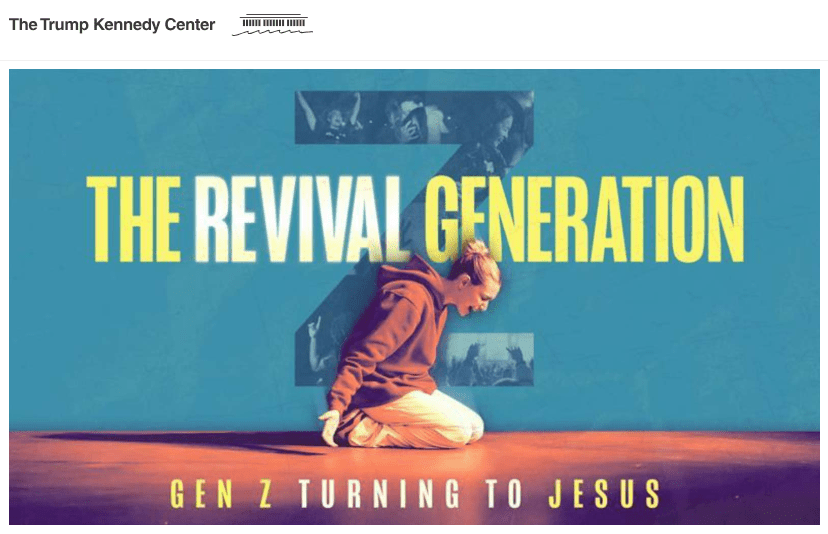
The John F. Kennedy Center for the Performing Arts hosted the red-carpet premiere of The Revival Generation, an explicitly evangelical Christian documentary produced by the Christian Broadcasting Network, marking a notable shift in how the nation’s premier cultural institution is being used under its current leadership.
The August 27, 2025 event took place in the Kennedy Center Concert Hall and was framed not simply as a film screening, but as a full-scale worship gathering, complete with prayer, religious music, and testimony. The program featured mass-baptism footage, campus revival scenes, and appearances by prominent evangelical figures, including former Trump Cabinet member Dr. Ben Carson.
The Kennedy Center is a federally chartered institution and America’s official living memorial to President John F. Kennedy. While it has historically hosted a wide range of cultural, religious, and international programming, critics said the premiere crossed from inclusion into institutional promotion of a specific religious movement.
A Change in Direction
Unlike private venues that regularly host faith-based programming, the Kennedy Center occupies a unique position as a publicly funded national cultural institution. Its board, largely reshaped during the Trump administration, now oversees programming decisions that critics say increasingly blur the line between cultural presentation and ideological advocacy.
Kennedy Center President Ambassador Richard Grenell publicly embraced the film’s religious message, describing the event as evidence of an emerging Christian revival in the United States. His remarks framed the Center not as a neutral host, but as an enthusiastic participant in the message being promoted.
“This wasn’t a church renting a theater for the night,” said one former arts administrator familiar with the Center’s governance. “This was the Kennedy Center using its prestige to elevate a religious revival narrative.”
Public Institution, Religious Promotion
The First Amendment allows religious expression in public spaces, but legal and cultural observers have long drawn a distinction between private use of public facilities and government-linked institutions actively promoting religious content.
In this case, the Kennedy Center promoted the event through official channels, co-branded the premiere, and structured the evening around worship elements — raising concerns that the institution was endorsing a specific faith tradition rather than simply providing access to a venue.
“This isn’t about Christianity being unwelcome,” said a constitutional scholar. “It’s about whether a federally chartered cultural memorial should function as a platform for religious evangelism.”
Culture War at a Cultural Memorial
The premiere fits into a broader pattern of cultural institutions becoming venues for ideological signaling amid heightened political polarization. Critics argue that the Kennedy Center, long viewed as a shared civic space, is increasingly being drawn into culture-war conflicts that risk undermining its role as a unifying national institution.
Supporters of the event defended it as an example of religious storytelling and free expression. But opponents said the issue was not the content of the film itself, but the decision by a public cultural institution to place its imprimatur on a religious movement closely associated with contemporary partisan politics.
“What makes the Kennedy Center special is that it belongs to everyone,” said a former board adviser. “When it starts signaling ideological alignment, that sense of shared ownership disappears.”
A Lasting Precedent
Whether the hosting of The Revival Generation will remain an isolated programming choice or signal a longer-term shift in the Kennedy Center’s institutional identity remains unclear. What is clear, critics say, is that the event established a precedent: the use of America’s most prominent cultural memorial as a stage for explicitly religious revival programming.
As debates continue over the role of government-linked institutions in an era of political and religious polarization, the Kennedy Center’s decision is likely to be cited as a case study in how cultural authority can be repurposed — and contested — far beyond the arts.
 Texas Reporter