
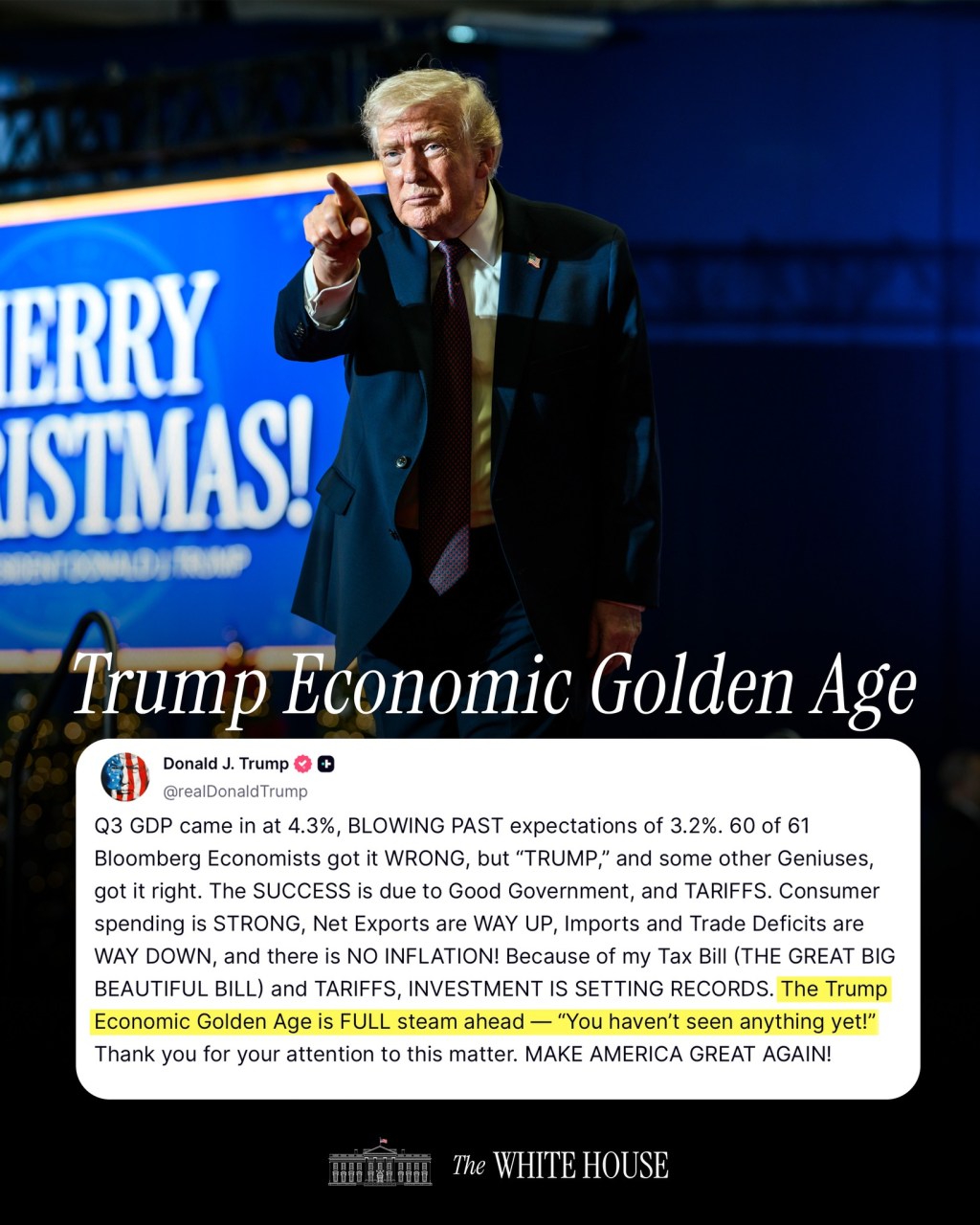
A White House social media post promoting a so-called “Trump Economic Golden Age” relies on selective statistics, misleading economic framing, and claims that conflict with widely accepted economic analysis.
The post, which amplifies a message from President Donald Trump, asserts that third-quarter GDP growth “blew past expectations,” that tariffs are driving investment, that trade deficits are shrinking, and that inflation is nonexistent. Economists say each of those claims either omits critical context or misrepresents how economic indicators work.
GDP Growth: Quarterly Optics vs. Economic Reality
The post highlights a 4.3% GDP figure as proof of exceptional economic performance. What it does not explain is that the number refers to an annualized estimate of a single quarter, not sustained year-over-year growth.
Quarterly GDP often fluctuates due to inventory changes, government spending cycles, or temporary trade effects. Economists caution against declaring long-term economic success based on a single quarter’s performance — particularly when other quarters show slower growth or contraction.
GDP growth also does not measure how benefits are distributed. Strong top-line growth can occur alongside stagnant wages, rising household debt, or uneven regional outcomes.
Tariffs and Trade: Claims at Odds With Basic Economics
The post credits tariffs with boosting investment and shrinking trade deficits. Most economists disagree.
Tariffs function as taxes on imports, and their costs are largely borne by domestic consumers and businesses. Numerous studies have shown tariffs raise prices, disrupt supply chains, and reduce competitiveness for U.S. manufacturers that rely on imported components.
Trade deficits are influenced by exchange rates, consumer demand, and global capital flows — not simply tariff policy. In prior tariff expansions, deficits shifted between countries rather than disappearing, while overall costs to consumers increased.
“No Inflation” Claim Contradicted by Market Data
The assertion that there is “NO INFLATION” directly contradicts standard economic indicators tracked by the Bureau of Labor Statistics and the Federal Reserve.
Inflation is measured across broad baskets of goods and services, including housing, food, energy, healthcare, and insurance — areas where consumers continue to report significant price pressure. Even when inflation slows, it does not mean prices fall; it means they rise more slowly.
Claiming inflation does not exist ignores the lived experience of households facing higher rents, insurance premiums, and borrowing costs.
Tax Cuts and Investment: Correlation vs. Causation
The post attributes “record” investment to tax cuts and tariffs. While corporate tax reductions can increase after-tax profits, evidence that they produce sustained domestic investment is mixed.
In previous tax-cut cycles, a significant share of corporate windfalls went toward stock buybacks and dividends rather than new factories, higher wages, or long-term productivity gains. Investment levels are influenced by interest rates, consumer demand, global stability, and workforce availability — not tax policy alone.
Branding vs. Economics
Perhaps most notably, the post frames economic performance as a personal branding achievement rather than a complex system shaped by global markets, independent monetary policy, and long-term structural forces.
Economists warn that politicizing short-term economic data risks misleading the public and obscuring genuine challenges — including affordability, debt levels, labor force participation, and productivity growth.
Bottom Line
The White House post presents a simplified narrative built around selective statistics and declarative slogans. While economic data can be debated, the claims made in the post omit essential context and contradict established economic analysis.
Strong economies are measured over time, across multiple indicators, and by how broadly prosperity is shared — not by a single quarter’s headline number or a social media slogan.
 Texas Reporter