
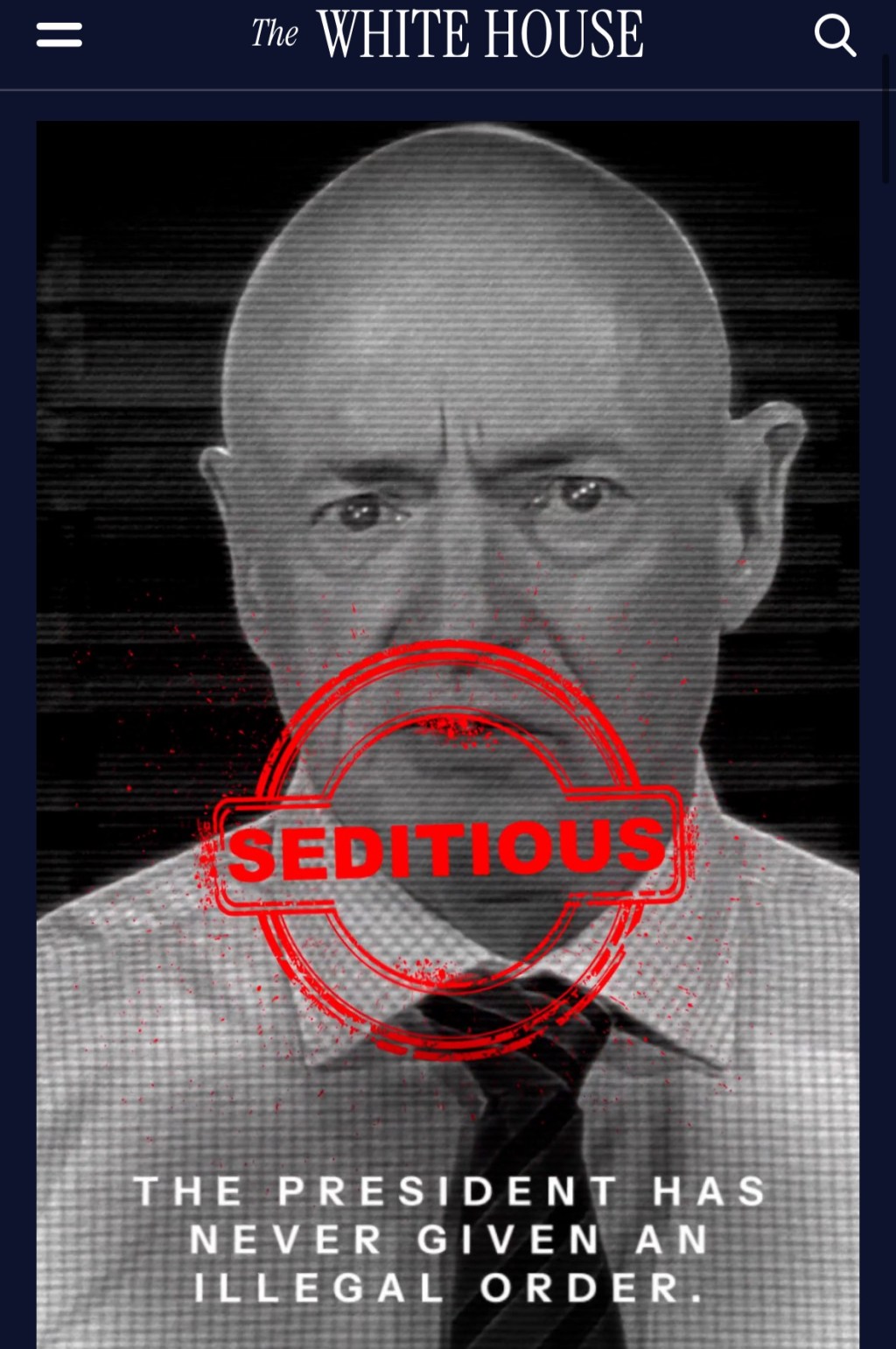
In an extraordinary break from long-standing professional norms, the White House this week used its official website to label multiple sitting Members of Congress and a U.S. Senator as “SEDITIOUS.” The lawmakers were targeted for appearing in a video reminding military personnel of a basic principle of U.S. law: service members must refuse illegal orders.
The video featured six elected officials, all with military or national security backgrounds:
Sen. Mark Kelly (Arizona) — Retired Navy Captain and combat veteran Sen. Elissa Slotkin (Michigan) — Former CIA analyst Rep. Jason Crow (Colorado) — Former Army Ranger Rep. Chris Deluzio (Pennsylvania) — Former U.S. Navy officer Rep. Chrissy Houlahan (Pennsylvania) — Former U.S. Air Force officer Rep. Maggie Goodlander (New Hampshire) — Former U.S. Navy intelligence officer
In the video, the group stated:
“Our laws are clear — you can refuse illegal orders,”
and
“Service members are sworn to the Constitution, not to any one person.”
None of the lawmakers accused President Donald Trump of issuing an illegal order. Their statements were general, accurate reflections of the Uniform Code of Military Justice, a standard teaching across all branches of the armed forces.
Nevertheless, the White House published an image on its website depicting participants in the video with a large red “SEDITIOUS” stamp over their faces. The accompanying text accused them of “inciting insubordination,” claimed without evidence that they were “subversively implying” the President had issued unlawful directives, and attacked multiple news outlets using language more commonly seen at political rallies than in official government communications.
A Break From Institutional Professionalism
For decades, White House communications — under both Republican and Democratic administrations — have been expected to maintain a professional, non-partisan tone. Presidential websites and official statements traditionally serve as informational resources, not platforms for personal attacks against elected officials.
The current action marks a significant departure from that norm.
It is exceedingly rare for the executive branch to use federal infrastructure to publicly denounce Members of Congress as criminals, particularly without a factual basis.
Former White House communications officials across several prior administrations have emphasized that official messaging is supposed to project restraint, credibility, and institutional neutrality — qualities seen as essential to preserving public trust.
Labeling lawmakers “seditious” for citing well-established military law is, they note, without modern precedent.
Professionalism Replaced With Partisan Combat
The rhetoric used in the White House post — including terms like “Fake News Media,” “dangerous,” and “seditious” — marks a clear shift from institutional communication to open political combat. The decision to publish such language on WhiteHouse.gov, rather than in a campaign setting, further blurs the line between governing and campaigning.
This is especially notable because the statements the lawmakers made are not legally or politically controversial. The duty to refuse an unlawful order is a foundational military principle taught from basic training onward and reflected in both the UCMJ and international law.
A Historically Unusual Use of Presidential Power
The choice to use official government communication channels to personally attack sitting members of the legislative branch represents a break with the practices of every modern administration. Even during periods of intense partisanship, past White Houses avoided framing elected officials as enemies of the state.
By elevating a straightforward legal reminder into accusations of sedition, the administration has taken an unprecedented step: turning an institutional tool of governance into an instrument of partisan denunciation.
It is not only the tone that stands out, but the target.
A president condemning political opponents is not new.
A presidency itself, through its formal instruments, condemning them as seditious is almost entirely without historical parallel.
Anomaly in U.S. Presidential Conduct
The episode reflects a broader shift in how presidential authority is being expressed. Rather than reinforcing professionalism and neutrality, the White House is embracing messaging that mirrors campaign rhetoric, even when directed at elected officials performing routine oversight of military and constitutional obligations.
Whether this remains an isolated incident or becomes a defining feature of executive communication remains to be seen.
But as historians point out, federal institutions typically rely on professionalism as a stabilizing force.
When the White House abandons that standard, it marks a meaningful — and historically significant — deviation.
 Texas Reporter