
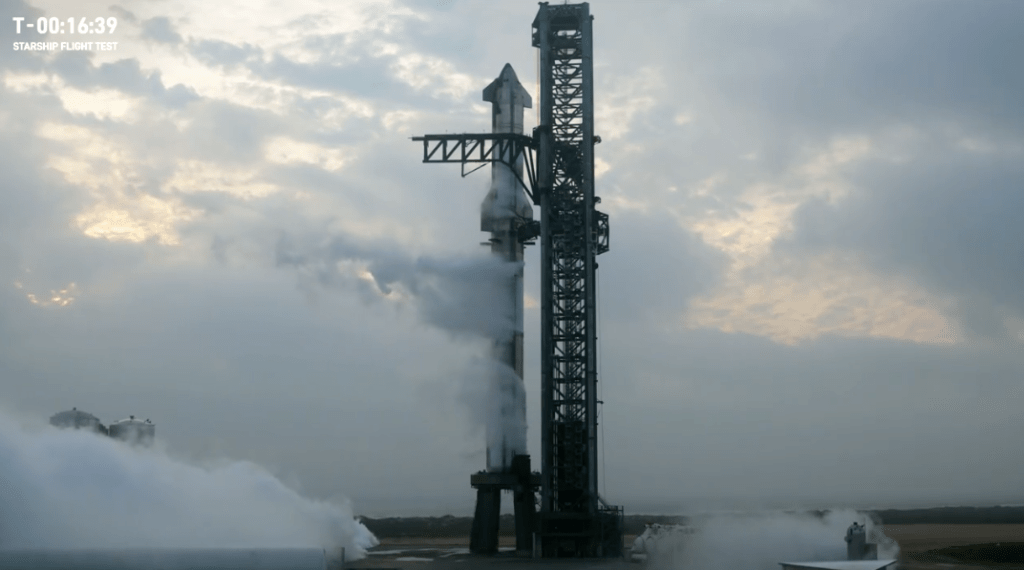
In an ambitious step forward for space exploration, SpaceX’s Starship completed its third flight test earlier today, demonstrating significant achievements as well as facing challenges during its launch from Starbase, Texas. The early morning liftoff at 8:25 a.m. CT marked a crucial phase in the spacecraft’s development, focusing on gathering data essential for its future missions.
This flight test was notable for successfully firing all 33 Raptor engines on the Super Heavy Booster, achieving a full-duration burn during ascent for the second time in its testing history. The mission also showcased a successful hot-stage separation, a critical maneuver where Starship powered down most of the Super Heavy’s engines, igniting six second-stage Raptor engines before the two vehicles separated.
Following the separation, the Super Heavy booster performed a flip maneuver and initiated a boostback burn towards its designated splashdown point in the Gulf of Mexico. Although the booster executed several engines for its landing burn, it ultimately experienced a rapid unscheduled disassembly (RUD) at about 462 meters in altitude, seven minutes into the mission.
Despite the booster’s setback, Starship’s second stage continued to achieve its objectives, including a full-duration ascent burn that propelled it to the expected orbit—a first for the spacecraft. The mission also tested new capabilities, such as operating its payload door and initiating a propellant transfer demonstration, though it skipped an on-orbit engine relight due to vehicle roll rates.
The spacecraft faced its first-ever entry from space, providing crucial data on heating and vehicle control during hypersonic reentry, with live views enabled by onboard Starlink terminals. The mission concluded approximately 49 minutes after launch, marking the end of data transmission via Starlink.
As SpaceX reviews the flight test data, preparations are already underway for future launches, aiming to increase the launch cadence throughout the year. This approach of rapid iterative development has underpinned SpaceX’s innovation, driving progress in creating a fully reusable transportation system designed to carry crew and cargo to Earth orbit, the Moon, Mars, and beyond.
SpaceX extended its gratitude to its customers, Cameron County, spaceflight enthusiasts, and the broader community for their ongoing support and encouragement, celebrating this significant milestone in the Starship program.
Image Source: Screenshot of SpaceX Video
 Texas Reporter